DIY

How to Make Custom Drawer Dividers That Fit Your Exact Dimensions
How to Make Custom Drawer Dividers That Fit Your Exact Dimensions

How to Make Custom Drawer Dividers That Fit Your Exact Dimensions

You know that feeling, right? You open a drawer, ready to grab that one thing you know is in there, and instead, you're greeted by a chaotic jumble of... stuff. Batteries rolling into rubber bands, pens tangled with paper clips, a desperate search for the nail clippers. It’s a mess, and it makes finding anything feel like an archaeological dig. 👋

I’ve definitely been there. My "junk" drawer used to be a black hole for anything small and easily lost. I’d buy those flimsy plastic organizers, only to find they didn’t quite fit, or the sections were too big, or too small, or they’d slide around every time I opened the drawer. Sound familiar?

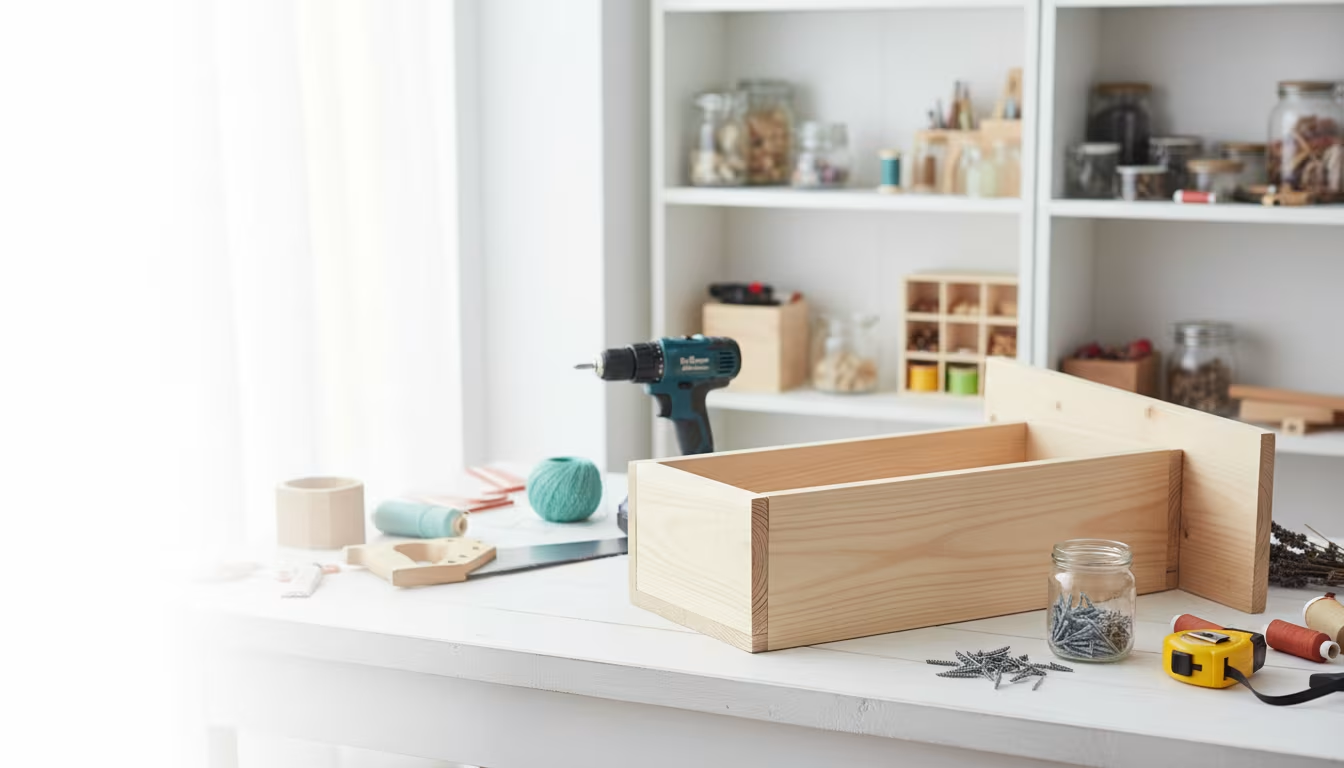
Today, we're tackling that specific brand of drawer chaos head-on. We're going to dive into how to make custom drawer dividers that fit your space perfectly. No more wasted space, no more shifting organizers, just pure, satisfying order. And don't worry, you don't need a fancy workshop for this – I've made some of my best sets with just a utility knife and some old cardboard.

Why This Actually Matters

Okay, so it's "just" drawer dividers, right? But let me tell you, bringing order to even one chaotic drawer can feel like a genuine win. It’s not just about aesthetics; it’s about efficiency and reducing tiny everyday frustrations.

I remember one morning, rushing out the door, desperate to find my extra car key. My designated "key" drawer was, of course, a disaster. Ten minutes of frantic digging, turning my kitchen upside down, and I almost missed my appointment. That’s when I finally hit my breaking point.

The next weekend, I decided that drawer was getting a makeover. When things have a specific home, you spend less time searching and more time doing what you actually want to do. It’s a small change, but it really adds up, especially when it comes to tools or craft supplies.

What Even ARE Custom Dividers? (And Why Store-Bought Just Doesn't Cut It)

When I talk about custom drawer dividers, I’m not talking about those expandable plastic trays you grab at the big box store. Those are fine for a quick fix, but they rarely, if ever, fit exactly right.

Custom dividers are essentially a grid system, tailor-made from pieces of material – often wood, MDF, or even sturdy cardboard – that slot together inside your specific drawer. They fill every available inch, creating perfectly sized compartments for whatever you need to organize.

Why "Off-the-Shelf" Often Falls Short

I've tried all the store-bought options, and they just never quite worked for me. Here's why you might be feeling the same frustration:

  • Standard Sizes Don't Match: Most drawers aren't perfectly rectangular or square in standard increments. That means those fixed-size organizers leave awkward gaps around the edges, creating little "junk zones" even within your organized drawer.
  • Wasted Space is Still Wasted Space: Even if an organizer mostly fits, those empty perimeter areas are still dead space. With custom dividers, you optimize every square inch, making your drawer work harder for you.
  • Things Still Shift and Migrate: Ever open a drawer only to find your "organized" items have all shifted into a new, disorganized pile? Store-bought dividers rarely stay put. Custom ones, by filling the entire space, are much more stable. They truly lock things into place.

Making your own means you get to dictate the size, shape, and number of compartments. You decide where the batteries go, where the charging cables live, and where your favorite washi tape finds its perfect little home. It's a game-changer for reclaiming your space.

How To Actually Do It: Gathering Your Tools & Materials

Alright, enough talking about the mess, let's get our hands dirty and actually make some dividers! The process is surprisingly straightforward, and you might already have most of what you need kicking around.

Step 1: The Great Drawer Purge & Measure

Before you even think about cutting, you need to empty that drawer completely. Yes, everything. This is your chance to declutter and decide what truly belongs in there. You'll probably find a few things you completely forgot you owned!

Once it's empty, grab a tape measure. You need three key dimensions:

  • Drawer Length: The inside measurement from the back to the front.
  • Drawer Width: The inside measurement from side to side.
  • Drawer Depth/Height: From the bottom of the drawer to just below the lip. Your dividers need to be shorter than this so the drawer can still close easily. I usually aim for about 1/4" to 1/2" shorter.

Jot these down. Seriously, write them down. I've been known to measure, walk to my workbench, and completely forget a number. It's frustrating! Now, take a minute to sketch out a rough layout. Think about what you're putting back in and what size compartments those items need. This is where your creativity starts to shine!

Step 2: Choosing Your Material (And Why Cardboard Is Your Best Friend)

This is where you get to decide how durable and how fancy you want your dividers to be. I’ve experimented with a few different options, and each has its place.

  • Sturdy Cardboard (My Favorite for Beginners!): This is hands-down the cheapest and easiest material to start with. Think old moving boxes, appliance boxes, or even poster board if you're organizing something super light. It's forgiving, easy to cut with a utility knife, and free! My very first set of junk drawer dividers were literally cut from a flattened Amazon box, and they’re still holding up years later.
  • Thin Plywood or MDF (1/8" to 1/4" thick): If you want something more robust and permanent, wood is a great option. It looks clean and professional, and it's much more durable, especially for kitchen drawers or tool organization. It does require a saw to cut, though. I usually grab small sheets from the hardware store; they're pretty affordable.
  • Foam Core Board: This is a good middle-ground. It’s light, easy to cut, and a bit more rigid than cardboard. It’s also usually white or black, so it looks a bit cleaner. It’s great for craft supply drawers or delicate items.

For your first attempt, I really recommend starting with cardboard. It takes away the pressure of "wasting" expensive materials and lets you learn the process without fear.

Step 3: Calculating Your Pieces (The Math Isn't Scary, I Promise!)

This is the step where most people get a little intimidated, but it’s actually pretty straightforward if you break it down. The key is to account for the thickness of your material.

Let's say your drawer is 18" long and 12" wide. You'll have two types of divider pieces: main (long) dividers and cross (short) dividers.

Main Dividers (running the length of the drawer):

  • These pieces will be the full length of your drawer, so 18" long.
  • Their height should be your chosen drawer depth (e.g., 3" tall if your drawer is 3.5" deep).
  • Decide how many you need. For example, if you want three main sections along the width, you'll need two main dividers.

Cross Dividers (running the width of the drawer):

  • This is where the material thickness comes in! Each cross divider needs to fit between your main dividers.
  • So, the length of a cross divider will be the drawer width (e.g., 12") MINUS the total thickness of all your main dividers.
  • If you're using cardboard that's 1/8" thick, and you have two main dividers, you'd calculate: 12" - (2 x 1/8") = 12" - 1/4" = 11 3/4" long.
  • Their height will also be your chosen drawer depth (e.g., 3" tall).

It's super important to subtract that material thickness. I once forgot this and ended up with cross dividers that were just a hair too long, making the whole grid wonky. Had to re-cut them all, which was a real pain. Measure and calculate carefully!

Step 4: Cutting Your Strips (Measure Twice, Cut Once!)

Now that you have your measurements, it’s time to cut your material into strips. Remember, you're making a grid, so all your pieces will be the same height (the drawer depth you decided on).

For Cardboard or Foam Core:

  • Grab a sturdy utility knife, a metal ruler, and a cutting mat (or an old piece of cardboard you don't mind scoring).
  • Line up your ruler and score the material lightly first. Don't try to cut all the way through in one pass, especially with thicker cardboard.
  • Make several passes, increasing pressure each time, until you cut cleanly through. This gives you straighter, cleaner edges and is much safer.
  • Cut all your main dividers and all your cross dividers to the lengths and heights you calculated.

For Thin Plywood or MDF:

  • If you're using a hand saw, a miter box will be your best friend for getting straight cuts. Clamp your material down securely before cutting.
  • For power tools like a circular saw or table saw, always use appropriate safety gear – eye protection, hearing protection, and push sticks. If you're new to these tools, get comfortable on scrap pieces first.
  • Take your time. A straight cut here means a snug fit later.

I can't stress this enough: cutting accurately here makes assembly so much easier later on. My first cuts were pretty rough, and I had to do a lot of trimming later. Practice on a scrap piece if you're feeling unsure!

Step 5: Making the Slots (The Clever Part!)

This is where the magic happens and your flat strips start to become a functional grid. You're going to cut slots halfway into each piece, allowing them to interlock.

Decide where you want your cross dividers to intersect your main dividers. Lay out one of your main divider strips flat. Using a pencil and ruler, mark where each cross divider will meet it. Do the same for your cross divider strips, marking where the main dividers will intersect them.

For Cardboard or Foam Core:

  • With your utility knife, carefully cut a slot at each marked point. The slot should be the exact width of your material (e.g., 1/8") and extend exactly halfway down the height of your divider strip. So, if your strips are 3" tall, each slot should be 1.5" deep.
  • It's easier to make these cuts with the material flat on your cutting mat. Use your metal ruler as a guide to keep your cuts straight.
  • Make sure the slots are clean. If they're too wide, your grid will be wobbly. If they're too narrow, the pieces won't slide together.

For Thin Plywood or MDF:

  • You can use a hand saw, a coping saw, or even a multi-tool for this. Again, clamp your piece securely.
  • Accuracy is key. You might want to make a test slot on a scrap piece to ensure your saw blade creates the correct width for a snug fit.
  • A chisel can help clean up the corners of your slots if needed.

This step often takes the most patience, especially the first time. I learned to make my slots slightly narrower than needed, then gently widen them with the tip of my knife or sandpaper until the pieces just barely fit. It's much easier to take away a little more material than to add it back!

Step 6: Assembling Your Grid (The Satisfying Moment)

Now for the fun part! Start by taking your main divider strips and your cross divider strips and carefully sliding the slots into each other. It's like putting together a 3D puzzle.

Work slowly and gently, especially if you're using cardboard, so you don't bend or tear the material. The goal is for the pieces to slide together snugly, creating a stable grid. Once assembled, it should feel fairly rigid.

Place the entire grid into your drawer. It should fit perfectly from front to back and side to side, with minimal gaps. If it's a bit too snug, you might need to trim a tiny sliver off the ends of your main dividers or widen a slot. If it's a bit too loose, you can often add a small dot of hot glue at the intersections to stabilize it.

Step 7: Adding the Base (Optional, But Recommended)

While the slotted grid is often enough to keep things organized, adding a base can really elevate your dividers. It prevents small items from sliding underneath the dividers and gives the whole structure more stability when you pull the drawer open and closed.

Measure the exact length and width of your drawer bottom. Cut a piece of your chosen material (cardboard, thin plywood) to these dimensions. Then, simply place your assembled grid on top of this base.

You can use a few dots of hot glue at the bottom of each divider strip to secure it to the base. For wood, wood glue or even small brad nails work well. This step truly locks everything in place and makes your custom dividers feel like they're built right into the drawer.

Step 8: Finishing Touches (Make It Pretty, Or Don't!)

This step is entirely up to you and the aesthetic you're going for. Sometimes, the raw material look is exactly what you want! My craft drawer dividers are just plain cardboard, and I love the utilitarian vibe.

  • Paint: If you used wood or foam core, a coat of paint can really transform them. Use a color that complements your drawer or interior. Just make sure the paint is fully dry before putting items back in.
  • Decorative Paper/Fabric: For cardboard dividers, you can cover them with decorative paper (like scrapbook paper) or even fabric using spray adhesive or Mod Podge. This is a fun way to add a personal touch and make your drawers feel extra special.
  • Sealant: If you made wood dividers for a kitchen or bathroom drawer, consider a clear sealant to protect them from moisture and spills.

Whatever you choose, take a moment to admire your handiwork. You just transformed a chaotic drawer into an organized, functional space! It's super satisfying, isn't it? ❤️

Making It Stick: Common Mistakes & How to Avoid Them

Even though this project is beginner-friendly, there are a few places where people (including me, many times!) tend to trip up. Knowing these pitfalls ahead of time can save you a lot of frustration.

  • Forgetting Material Thickness in Calculations: This is the big one. As I mentioned, if you don't subtract the thickness of the divider material from your cross-piece lengths, your grid will be too wide. Always double-check your math before cutting.
  • Inaccurate Measuring: A tiny difference in your initial drawer measurements can mean your whole grid is too loose or too tight. Use a reliable tape measure and measure twice, even three times, to be sure.
  • Cutting Slots Too Wide or Too Shallow: If your slots are too wide, the pieces won't interlock snugly, and the grid will be wobbly. Too shallow, and they won't fully connect. Aim for the exact width of your material and exactly halfway through the height of your strip.
  • Rushing the Cutting: Whether it's cardboard or wood, rushing leads to crooked cuts, splintered edges, and uneven strips. Slow and steady wins the race here. Take your time, use a straight edge, and make multiple passes if necessary.
  • Not Planning the Layout: Trying to just "wing it" without sketching out your desired compartments first is a recipe for wasted material. Think about the items you're organizing and what size cubbies they actually need.
"Organization isn't about perfection; it's about making your everyday a little easier. Your craft space should serve you, not the other way around. Don't be afraid to make a mess while trying to make things better."

Frequently Asked Questions

What's the easiest material to start with for custom drawer dividers?

Definitely sturdy cardboard from old shipping boxes. It's free, super easy to cut with just a utility knife, and forgiving if you make a mistake. It’s perfect for getting the hang of the measuring and slot-cutting process without any pressure.

My dividers are too loose/too tight, what did I do wrong?

This usually comes down to your slot depth or width, or maybe your overall piece lengths. If too loose, a tiny dot of hot glue at the intersections can often stabilize the grid. If too tight, carefully widen the slots with your knife or sandpaper until they fit, or trim a hair off the ends of your main dividers.

Can I use custom dividers in kitchen drawers with cutlery?

Absolutely! For kitchen drawers, especially with cutlery, I'd strongly suggest using thin plywood or even acrylic for better durability and easier cleaning. If you use wood, consider sealing it with a food-safe finish to protect against moisture and food residue.

How long does a project like this usually take for a beginner?

For a medium-sized drawer using cardboard, plan for about 2-3 hours from start to finish, including the planning and measuring. If you're working with wood, it might take a bit longer, perhaps 3-5 hours, due to more precise cutting and potential sanding. My first one took me a whole Saturday because I kept re-measuring!

Is this worth it if I might change my drawer layout later?

Yes, absolutely! If you used cardboard, it's virtually free to make a new set if your needs change. With wood, you can often reuse the pieces for smaller projects, or reconfigure them. The skills you learn in measuring and cutting are transferable to so many other DIY projects, making the time investment totally worth it.

The Bottom Line

Don't let a chaotic drawer cramp your style or waste your time anymore. Making custom drawer dividers is one of those DIY projects that feels incredibly rewarding and genuinely improves your everyday life. It’s a practical skill, a clever hack, and a fantastic way to transform a small corner of your home.

You don't need fancy tools or years of experience. Just a ruler, a cutting tool, and a bit of patience. Pick one problem drawer this weekend, gather some old cardboard, and give it a try. You'll be amazed at the difference a little custom organization can make. You’ve got this!

Laura Hayes
Written by

Laura Hayes

Maker and craft enthusiast from Portland, Oregon. I've been documenting my DIY journey since 2019 - everything from woodworking to paper crafts. When I'm not in my garage workshop, you'll find me hunting for supplies at thrift stores.