
Why Latch Hooking is the Retro Craft You Need to Try This Year
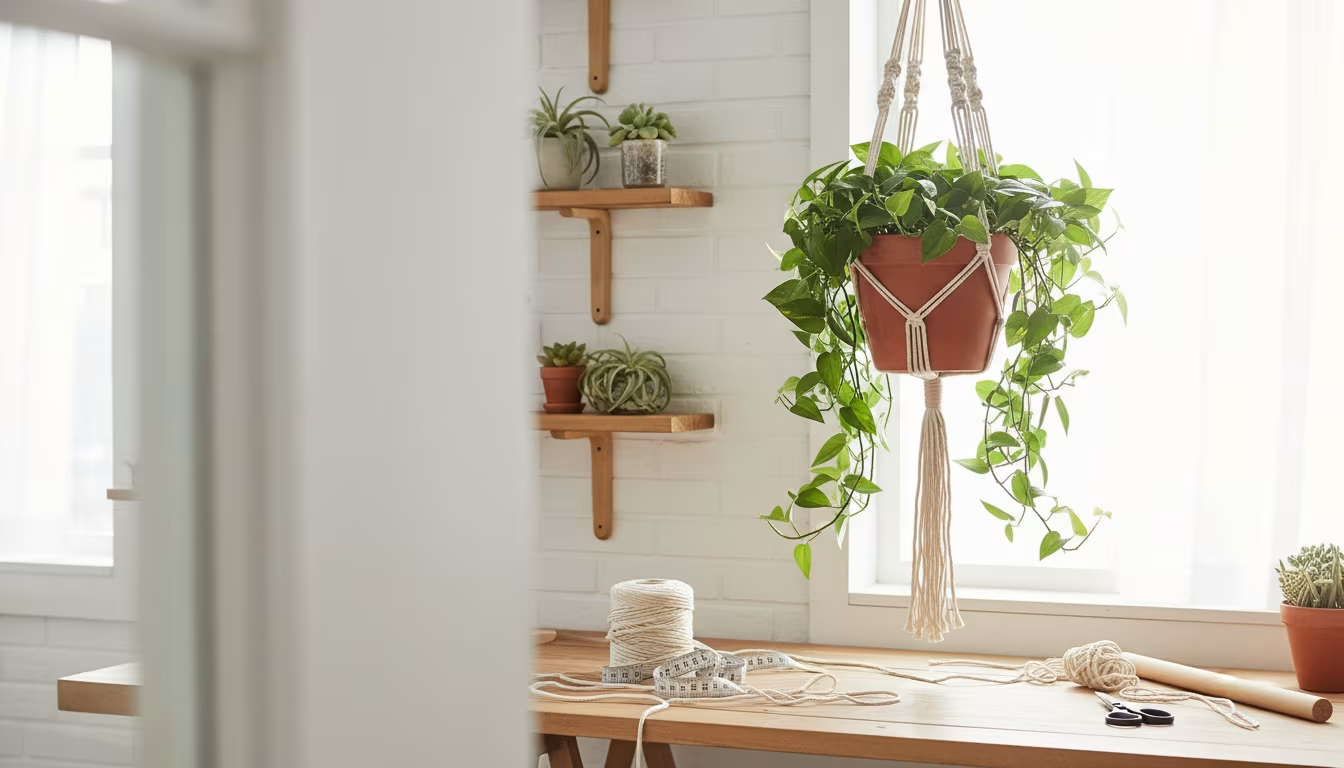
Latch hooking has a dated reputation, filed somewhere between shag rugs and grandma's spare room. That reputation is out of date. It is one of the most beginner-friendly fiber crafts there is: a single repeated knot, cheap supplies, and modern patterns that lean abstract and graphic rather than cartoonish. It is also genuinely calming, which is most of the reason it is back. Here is exactly how it works, what to buy, and how to avoid the handful of mistakes that trip up first-timers.
What Latch Hooking Actually Is
Latch hooking is a fiber technique where you use a hinged hook to tie short lengths of yarn onto a gridded canvas, one square at a time. Each knot loops around a strand of the grid and builds up a dense, plush pile. Fill every square and you have a rug, a cushion front, or a wall hanging with a thick, carpet-like surface.
The technique dates to its 1970s and 1980s heyday, when kits for rugs and wall hangings were everywhere. It faded, then returned with contemporary designs. The mechanics have not changed: if you can tie a shoelace, you can latch hook. The steepest part of the learning curve is usually choosing colors.
Why It Is Worth Trying
The draw is rhythm. The motion is simple and repetitive, which makes it easy to do while listening to a podcast, and easy to put down and pick back up. There is no measuring, no power tools, and no complex stitch counting the way knitting or crochet demands. You learn one motion and repeat it.
It is also inexpensive and forgiving. A beginner kit runs roughly $15 to $30 and includes everything for a small project; a first abstract wall hanging of maybe 8 by 8 inches takes only a few evenings. Wonky early knots do not ruin anything, because the dense pile hides small inconsistencies. For color and fiber guidance beyond the kit, the Craft Yarn Council publishes standard yarn weight information that helps when you start substituting your own materials.
The Four Supplies You Need
The whole craft comes down to four components, most of which arrive together in a kit.
- The canvas. A stiff mesh grid, usually cotton or nylon, of evenly spaced open squares. The square size sets the pile density. You can buy blank canvas or, easier for beginners, pre-printed canvas with the design already color-mapped square by square.
- The yarn. Latch hook yarn comes pre-cut into uniform lengths, typically 2.5 to 3 inches, so every loop finishes at the same height. It is usually acrylic: durable, cheap, and available in a huge color range. You can also cut your own from skeins for custom designs.
- The latch hook tool. A metal hook with a small hinged latch near the tip that opens and closes automatically as you work, catching and securing the yarn. It runs only a few dollars and usually has a wood or plastic handle.
- The pattern. Either printed directly on the canvas or supplied as a separate gridded chart, where colored squares tell you which yarn goes where. It reads like paint-by-number.
Scissors are optional until the end, for trimming stray loops. That is the entire kit.
Reading the Canvas and Pattern
Look closely at the canvas and you will see rows and columns of small squares; each holds exactly one knot. With a pre-printed canvas, the work is straightforward: match the yarn color to the printed color under each square. Start in a corner, usually bottom left, and work across a full row so you do not skip squares.
A blank canvas paired with a paper chart takes more tracking, the way a knitting or cross-stitch chart does. Count rows and columns carefully, use a ruler or a removable marker to hold your place, and cross off squares on the paper as you finish them. On a large piece that habit saves real time and frustration.
The Latch Hook Knot, Motion by Motion
This single knot is the whole craft. Break it into small movements the first few times, and it soon becomes one fluid gesture.
- Fold one piece of yarn in half into a U-shape and hold it at the middle.
- With the latch open, slide the hook tip under one horizontal strand of the grid, entering from the bottom of the square and coming out the top.
- Drape the U of yarn over the hook so both ends hang on either side.
- Pull the hook back through the square. As it comes back, the yarn catches the latch and snaps it closed automatically, drawing the yarn into a loop around the strand.
- Keep pulling until the hook tip emerges from the loop, then release the hook and pull both yarn ends firmly and evenly. That cinches the knot tight against the grid.
Give each finished knot a small tug to confirm it is snug; you should see a neat, upright tuft. It reads as many steps on paper and takes about three seconds once your hands learn it.
Working Through a Project
From there you simply repeat the knot, square by square, usually working left to right and then up a row. Keep checking colors against the pattern; drifting into the wrong shade for a few squares is the single easiest mistake to make. Aim for roughly even tension on every pull so the finished pile stays uniform in height.
Mistakes undo easily. Slip the hook under a bad knot, release the yarn, and redo it, so there is no penalty for fixing a wrong color or a loose loop. Take breaks, too: the repetition is the point, but tired hands and eyes lead to skipped squares. If you cut your own yarn, wrap it around a cardboard template and snip both ends to keep every length identical, and only cut enough for the section you are on to avoid tangles.
A few working habits speed things up. Keep each color in its own small bowl or zip bag so you are not hunting for a shade mid-row. On a wide piece, hook in vertical color blocks rather than strictly row by row when a design has large solid areas, since staying in one color reduces tool swaps. And keep the finished pile facing you as you work, so you can spot a missed square or a knot that sits lower than its neighbors while it is still easy to fix. On a standard 3.75-holes-per-inch rug canvas, a filled square uses roughly one pre-cut length, which makes estimating yarn quantities straightforward: count the squares of each color on the chart and buy accordingly.
Finishing the Edges
Filling every square is not quite the finish line, because the raw canvas edge needs to be handled. For a rug, fold the canvas margin under and either sew it down or use fabric glue for a clean border, then add a non-slip backing for safety. For a wall hanging, bind the edges with fabric strips or slide a dowel rod through the top edge to hang it. For a cushion, sew the hooked panel to a backing fabric, leave a gap to insert the pillow form, and stitch it closed.
If loops look slightly uneven, trim them lightly with sharp scissors to level the pile, taking care not to cut too short. Beyond rugs, the same technique makes coasters, seat cushions, tote-bag fronts, and textured wall art.
Common Mistakes
Uneven loop height comes from inconsistent pull force or slightly different yarn lengths. Tension evens out with practice, and a gentle end-trim levels the surface. Losing your place plagues blank-canvas work; slide a ruler under the active row or lightly outline color blocks with a washable marker. Splitting or fraying yarn as you pull usually means too much force, low-grade yarn, or a burr on the hook, so ease off the pull and inspect the hook tip. The subtler trap is getting overwhelmed by a big project. Latch hooking is slow by nature, so break a large rug into targets, one color block or a 10-by-10 square per session, and let small wins carry you. The goal is not machine perfection; slight irregularity is what marks a piece as handmade.
Common Questions
Is it hard to learn? No. The knot clicks within minutes, and it is easier than knitting or crochet because there is only one motion to master. Latch hook is often cited among the easiest first fiber projects.
What yarn is best? Pre-cut acrylic latch hook yarn for beginners: cheap, colorful, durable, and less prone to splitting. Wool is more durable for heavy-traffic rugs but costs more and is fussier to work.
Where do patterns come from? All-in-one kits are the simplest start. Free charts are widely available online, craft shops sell paper patterns, and you can design your own on grid paper with colored pencils. The history and mechanics of the craft are summarized on the latch hook reference page.
How long does a project take? An 8-by-8-inch piece runs about 3 to 6 hours; a medium pillow cover 10 to 20; a 2-by-3-foot rug can top 50 hours.
Can I wash a finished piece? Acrylic pieces tolerate spot cleaning with mild soap. Small items can be hand washed or run on a delicate cold cycle in a mesh bag, then air dried flat. Avoid heat and harsh chemicals.
Is it expensive? No. A kit is $15 to $30, and bought separately the hook is a few dollars with affordable canvas and yarn, making it one of the more budget-friendly crafts to try.
Latch hook time estimates:
| Project | Hours | Note |
|---|---|---|
| 8×8 in piece | 3–6 | kit $15–$30 covers a small project |
| Pillow cover | 10–20 | — |
| 2×3 ft rug | 50+ | break into 10×10 blocks per session |
| Yarn math | pre-cut 2.5–3 in; ~1 length per canvas square | standard 3.75-holes-per-inch canvas |
Related Posts

Beginner Pottery Wheel Speed for Centering
Centering clay needs high wheel speed and firm pressure. Most beginners use too low speed.

Calligraphy Ink Comparison for Cotton Paper
Modern dip pen calligraphy needs ink that doesn't bleed on absorbent cotton paper. India ink...
Knitting Needle Materials Compared: Wood vs Metal vs Plastic
Knitting needle material changes how stitches slide, how cold or warm the needle feels, and how...
Beginner Watercolor Paper Choice for Textured Washes
Watercolor paper is the single biggest gear decision a beginner makes. Weight, surface texture...
Comments
No comments yet. Be the first to share your thoughts!