
How to Build a Tabletop Kiln for Small Ceramic Projects
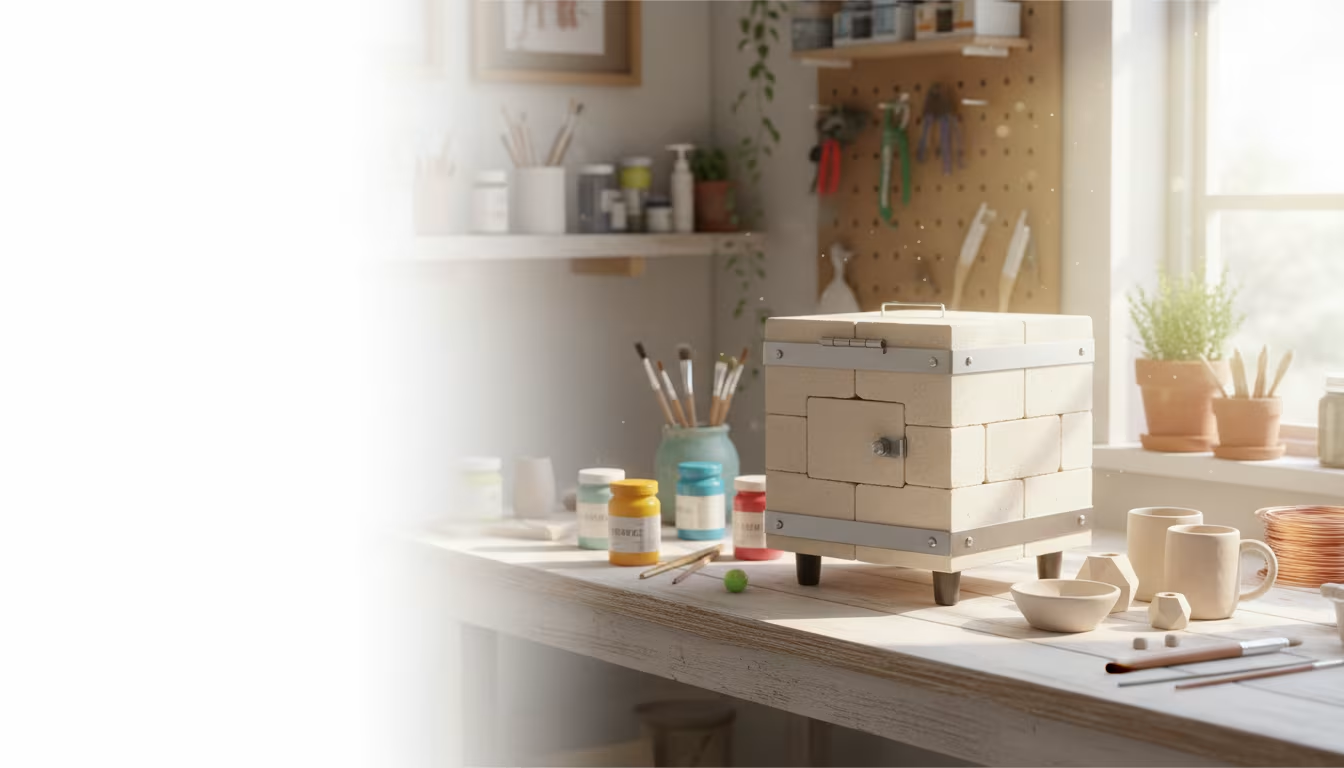
Firing is the barrier that keeps most people out of ceramics. A commercial kiln costs several hundred to a few thousand dollars and needs a dedicated 240-volt circuit, and shipping work to a community studio adds a week and a fee to every batch. A small tabletop kiln solves the problem for low-fire work: earrings, small figurines, ring dishes, decorative tiles. It will not fire stoneware or porcelain, but for earthenware and low-fire glazes it gives you same-day turnaround at home. This is also a project involving electricity and temperatures over 1700°F, so read the safety sections as carefully as the build steps.
What a small kiln can and cannot do
A tabletop kiln is an insulated chamber with a heating element that reaches the temperature range needed to harden and, later, glaze clay. The basic principle of a kiln is simple: trap heat around the work long enough to drive chemical and physical changes in the clay body. The limit is temperature. Home-built kilns comfortably reach the earthenware range but rarely hit the 2200°F-plus that stoneware and porcelain demand.
- Bisque firing: the first firing, which converts fragile greenware into hard, porous ceramic ready for glaze.
- Low-fire glazing: glazes formulated to mature between roughly 1800°F and 1940°F (cone 06 to cone 04).
- Small batches: a few thumb-sized pieces per load, with space around each one.
- Not high-fire: no stoneware, no porcelain, no reduction atmospheres.
Firing temperatures and pyrometric cones
Potters describe firing by "cone," a reference to pyrometric cones that bend at a known heat-work value rather than by raw temperature alone. For a home kiln, match your clay and glaze to the low-fire cones below and confirm the kiln can hold that heat steadily.
| Firing stage | Cone | Approximate temperature |
|---|---|---|
| Bisque (earthenware) | Cone 04–06 | 1830–1915°F (999–1046°C) |
| Low-fire glaze | Cone 06–04 | 1830–1940°F (999–1060°C) |
| Warm-up / drying hold | — | 200–300°F (93–149°C) |
| Stoneware (out of range) | Cone 5–6 | 2165–2232°F (1185–1222°C) |
Gathering the materials
The core requirement is that everything inside the hot zone must be refractory, meaning rated to survive repeated high heat without cracking or warping. Ordinary bricks, garden pavers, and terracotta tile will fail, sometimes violently.
- Outer shell: a thick-walled metal container, such as a 5-gallon galvanized bucket or a cleaned, fully vented steel drum. Never use a sealed container.
- Insulation: ceramic fiber blanket, or vermiculite/perlite packed with refractory cement. Plan on a layer at least 2 to 3 inches thick all around.
- Inner structure: insulating firebricks (soft brick) and a kiln shelf or fire tile for the base.
- Heating element: a coil element sold for kiln repair, sized to your voltage. This is not a place to improvise from scrap appliance parts.
- Controls: a thermocouple and a basic digital controller, strongly recommended so you are measuring temperature rather than guessing.
Where to find parts affordably
Metal buckets and drums turn up at garage sales and scrapyards for a few dollars. Insulating firebrick and ceramic fiber sometimes appear as offcuts at construction sites or through ceramic-supply clearance. The element and controller are the parts worth buying new from a ceramic supplier, because a correctly rated element is the difference between a kiln that reaches cone 04 and one that stalls at 1200°F.
Building the kiln step by step
Step 1: Prepare the shell
Clean the container and file down any sharp edges. Decide where the element enters, usually low on the side wall, and drill a hole just large enough for the element leads to pass through so you can seal it later. Thick metal takes several bits and patience; go slow to avoid wandering.
Step 2: Mount the heating element
This is the most safety-critical step. Secure the element with its supplied insulators or brackets so it cannot sag against the work or the shell. Every electrical connection must be insulated, strain-relieved, and kept out of the direct heat path. If you are not confident reading an element's wiring rating, stop and bring in someone who is, or use a local makerspace with staff. A shorted element inside a metal shell is a shock and fire hazard.
Step 3: Build the inner chamber
Lay insulating firebrick into a small chamber and set a kiln shelf or fire tile as the floor your work will sit on. Leave a consistent gap between this inner box and the outer shell for insulation. The chamber only needs to be a little larger than your biggest piece plus clearance.
Step 4: Pack the insulation
Fill the gap with ceramic fiber blanket, or a vermiculite-and-refractory-cement mix packed at least 2 to 3 inches thick. Wear gloves, a respirator, and eye protection, because both fiber and dry refractory dust are respiratory irritants. Follow the cement's cure schedule exactly before firing; trapped moisture flashing to steam can crack the whole liner.
Step 5: Seal and add ventilation
Seal gaps, especially around the element entry, with high-temperature refractory cement. Provide a small vent opening so gases from burning off glaze binders and organic material can escape, and route the power cord away from the hot zone. A tight-but-vented chamber holds heat while letting fumes out.
Power draw and wiring realities
A small kiln element on a standard North American 120-volt, 15-amp household circuit can safely pull roughly 1400 to 1800 watts, about the same as a space heater. That is enough to reach the low-fire range in a modest chamber but not much more, which is why these builds stay small. Do not run the kiln on the same circuit as other heavy loads, and never chain it through a lightweight extension cord; use a heavy-gauge cord rated for the full amperage or plug directly into the wall.
Match the element's rated voltage and wattage to your outlet before buying, and confirm your breaker can carry the continuous draw. If you want faster heating or a slightly larger chamber, that pushes you toward a 240-volt element and a dedicated circuit, which is electrician territory, not a casual DIY step. When in doubt, keep the chamber small and the wattage within a single 15-amp circuit.
Rough cost of the build
Part of the appeal is price. A salvaged metal bucket or drum runs a few dollars, insulating firebrick is a few dollars apiece, and a bag of vermiculite is inexpensive at a garden store. The element is the main new purchase, commonly in the $30 to $80 range depending on size, and a basic thermocouple-and-controller set adds another $40 to $120. Altogether a functional low-fire kiln lands well under the cost of even the smallest commercial unit, with the controller being the one upgrade worth paying for because it removes guesswork from every firing.
The first test firing
Never load real work into an untested kiln. Run an empty firing first, ideally in a garage or outdoors with good airflow. Bring it up slowly and watch the thermocouple. A working small kiln should climb past 1000°F within the first hour or so and continue toward the low-fire range while the outside of the shell stays only warm to the touch, not hot. Expect smoke and odor on the first run as binders and residues burn off; that is normal for the maiden firing, but any electrical smell, sparking, or a shell that gets too hot to touch means shut it down immediately.
Loading and firing schedules
Do not overcrowd. Leave at least an inch between pieces and between work and the walls so heat circulates evenly; crowded loads underfire in the middle and leave glaze unmelted. Set small pieces on the shelf or on fire tile, never touching the element.
A home firing runs simpler than a programmed commercial cycle. For earthenware bisque, aim for the cone 04–06 range and hold, or "soak," at temperature for roughly an hour so the heat penetrates fully. Reaching temperature typically takes 2 to 4 hours in a small kiln; a complete cycle including cool-down often spans 12 hours or more. Cooling matters as much as heating: let the kiln return to room temperature on its own before opening.
Glaze firing follows bisque and demands more care with placement. Glazed surfaces must never touch each other or the shelf, because melted glaze fuses pieces together permanently. Leave a clear margin around every item, and stilt or dry-foot each piece so the glazed area does not weld to the shelf. Ramp the early stage slowly, especially through the first few hundred degrees, to let any remaining moisture and glaze binders burn off before the surface begins to melt; rushing this stage is what causes pinholing and blistering in the finished glaze.
Mistakes that ruin a firing
Wrong materials in the hot zone
Terracotta tile, ordinary brick, and non-refractory metal crack, spall, or warp under repeated firing. One cracked shelf can dump your work mid-cycle. Use only rated firebrick and kiln shelves inside.
Opening too soon
Thermal shock cracks glazed pieces and can make them snap. However tempting the peek, wait until the kiln is fully cool, usually overnight. This also protects you from a face full of superheated air.
Firing blind
Without a thermocouple you are guessing, which leads to underfired, chalky pieces or overfired, slumped ones. A pyrometric cone placed where you can see it, or an inexpensive controller, removes the guesswork and saves wasted clay.
Ignoring ventilation and supervision
Fire only in a well-ventilated space, keep a fire extinguisher within reach, and never leave the kiln running unattended. Set it on a stable, non-flammable surface with nothing combustible nearby, and never operate it in a living or sleeping area. Treated with that respect, a tabletop kiln turns a corner of a garage into a working ceramics studio for small, low-fire pieces you can design, glaze, and finish in a single weekend.
Related Posts
Beginner Pottery Wheel Speed for Centering
Centering clay needs high wheel speed and firm pressure. Most beginners use too low speed.

Calligraphy Ink Comparison for Cotton Paper
Modern dip pen calligraphy needs ink that doesn't bleed on absorbent cotton paper. India ink...
Knitting Needle Materials Compared: Wood vs Metal vs Plastic
Knitting needle material changes how stitches slide, how cold or warm the needle feels, and how...
Beginner Watercolor Paper Choice for Textured Washes
Watercolor paper is the single biggest gear decision a beginner makes. Weight, surface texture...
Comments
No comments yet. Be the first to share your thoughts!